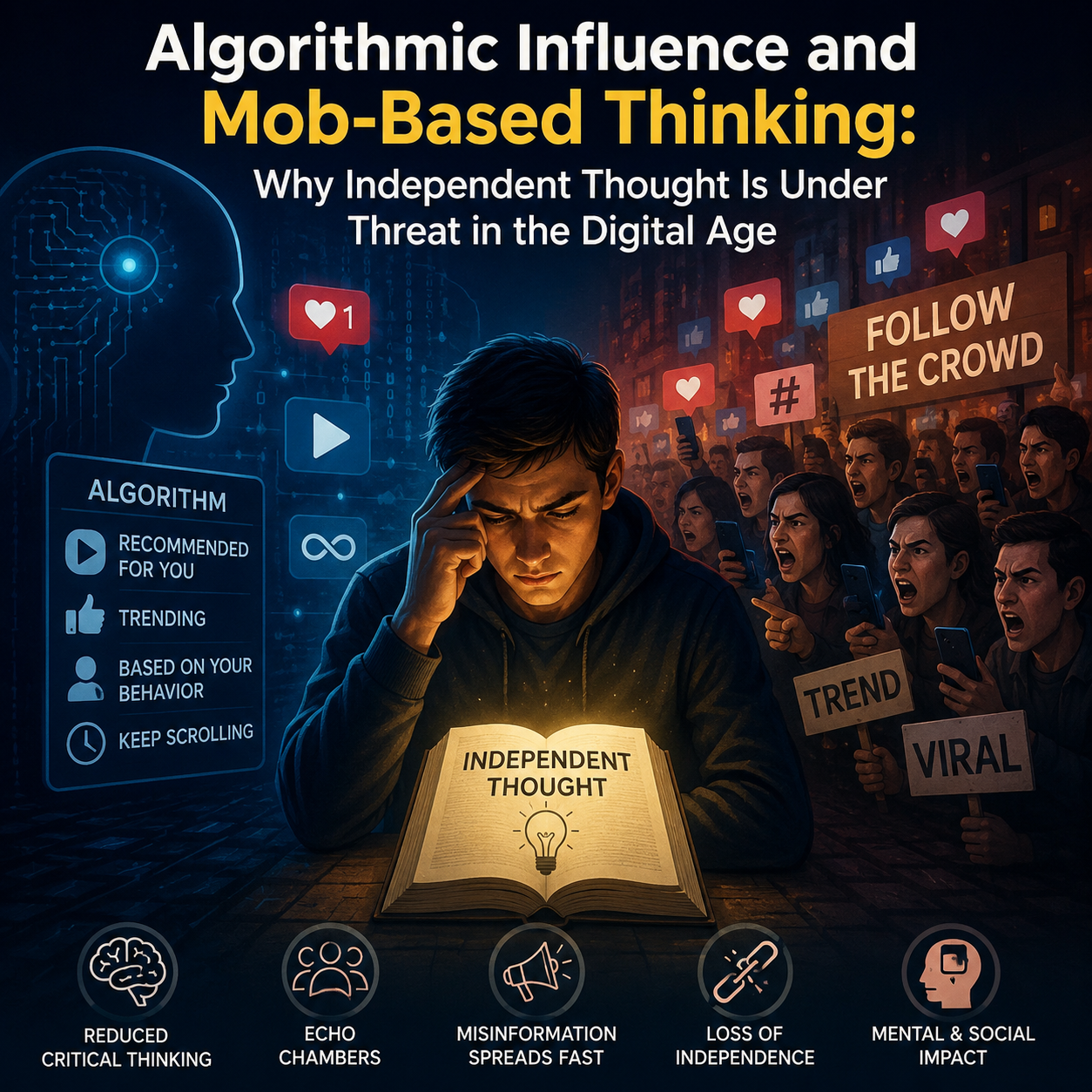
Algorithmic Influence and Mob-Based Thinking: Why Independent Thought Is Under Threat in the Digital Age
Algorithmic Influence and Mob-Based Thinking: Why Independent Thought Is Under Threat in the Digital Age
Introduction
The digital revolution has transformed the way people communicate, learn, consume information, and form opinions. Never before in human history has knowledge been so accessible. A smartphone connected to the internet can provide answers to almost any question within seconds. Yet, paradoxically, the abundance of information has not necessarily produced a more thoughtful society. Instead, many observers argue that independent thinking is increasingly being replaced by algorithmic influence and mob-based thinking.
Social media platforms, search engines, recommendation systems, and artificial intelligence tools shape what billions of people see every day. These systems are powered by algorithms designed to maximize engagement rather than promote balanced understanding. At the same time, online communities often encourage conformity, rewarding popular opinions while discouraging dissenting viewpoints.
British writer and philosopher Johny Thomson has frequently emphasized the importance of critical thinking and philosophical inquiry in modern life. Through his writings, Thomson argues that the ability to question assumptions and evaluate evidence is becoming increasingly important in a world saturated with information. His insights provide a valuable framework for understanding the growing influence of algorithms and collective thinking patterns.
This article explores the causes, consequences, future implications, and societal costs of algorithm-driven and mob-based thinking, while highlighting why critical thinking remains essential for educated individuals.
Algorithmic Influence and Mob-Based Thinking
Understanding Algorithmic Thinking and Mob-Based Thinking
What Is Algorithmic Influence?
Algorithms are sets of instructions used by digital platforms to determine what content users see. They analyze user behavior, interests, clicks, likes, shares, and watch history to predict what will keep users engaged.
For example:
- A user who watches political videos will be shown more political content.
- Someone interested in fitness will receive similar recommendations repeatedly.
- News feeds prioritize content that generates strong emotional reactions.
Over time, users are exposed to a narrow range of viewpoints that reinforce their existing beliefs. This phenomenon is often referred to as an echo chamber or filter bubble.
What Is Mob-Based Thinking?
Mob-based thinking, often known as herd mentality or groupthink, occurs when individuals adopt opinions primarily because they are popular rather than because they are supported by evidence.
In digital environments, mob thinking manifests through:
- Viral trends
- Online outrage campaigns
- Mass sharing of unverified information
- Social pressure to conform
People increasingly judge ideas based on popularity metrics such as likes, shares, comments, and followers rather than objective reasoning.
Algorithmic Influence and Mob-Based Thinking
Johny Thomson and the Importance of Critical Thinking
Johny Thomson’s work focuses on making philosophy accessible to modern readers. One of his recurring themes is that thinking critically is not simply an academic skill but a practical necessity.
According to Thomson, modern individuals are exposed to an overwhelming amount of information every day. The challenge is no longer finding information but distinguishing truth from manipulation, evidence from opinion, and reason from emotion.
His perspective aligns closely with concerns about algorithmic influence. When people stop questioning the information they consume, they become vulnerable to misinformation, propaganda, and collective irrationality. Thomson encourages readers to cultivate skepticism, intellectual humility, and logical reasoning—qualities that serve as defenses against both algorithmic manipulation and mob psychology.
Causes Behind the Rise of Algorithmic and Mob-Based Thinking
1. Social Media Business Models
Most digital platforms generate revenue through advertising. Their success depends on maximizing user engagement.
As a result, algorithms prioritize content that:
- Triggers strong emotions
- Encourages reactions
- Keeps users scrolling
Unfortunately, emotionally charged content often spreads faster than balanced or nuanced information.
Algorithmic Influence and Mob-Based Thinking
2. Information Overload
Modern individuals encounter more information in a single day than previous generations encountered in weeks.
Faced with this overload, many people rely on shortcuts:
- Trusting popular opinions
- Following influencers
- Accepting trending narratives
These shortcuts reduce cognitive effort but weaken independent analysis.
3. The Desire for Social Acceptance
Humans are inherently social creatures. Throughout history, belonging to a group increased survival chances.
In the digital era, this instinct remains powerful. People often avoid expressing unpopular opinions because they fear criticism, exclusion, or online backlash. Consequently, conformity becomes more attractive than independent thinking.
4. Declining Attention Spans
Short-form content dominates modern media.
Platforms encourage users to consume:
- 30-second videos
- Short posts
- Quick summaries
While convenient, this format often discourages deep analysis and reflective thinking.
5. Educational Gaps in Critical Thinking
Many educational systems focus heavily on memorization and standardized testing rather than reasoning and argument evaluation.
As a result, individuals may graduate with extensive knowledge but limited ability to analyze information independently.
Algorithmic Influence and Mob-Based Thinking
The Psychological Mechanisms Behind Mob Mentality
Several psychological factors contribute to mob-based thinking:
Confirmation Bias
People naturally seek information that confirms their existing beliefs while ignoring contradictory evidence.
Social Proof
Individuals often assume that if many people believe something, it must be true.
Fear of Isolation
Many people suppress their genuine opinions to avoid social rejection.
Emotional Contagion
Emotions spread rapidly online. Anger, outrage, fear, and excitement can influence large groups within minutes.
Algorithms frequently amplify these tendencies because emotionally engaging content generates higher interaction rates.
Effects on Individuals
1. Loss of Independent Judgment
When people rely heavily on algorithms and popular opinion, they gradually lose confidence in their own reasoning abilities.
Instead of asking:
“What do I think?”
they ask:
“What is everyone else thinking?”
2. Reduced Intellectual Curiosity
Algorithmic recommendations often show users more of what they already enjoy. This limits exposure to new ideas and perspectives.
As curiosity declines, intellectual growth slows.
3. Increased Polarization
People become trapped within ideological bubbles where opposing viewpoints are rarely encountered.
This leads to:
- Political division
- Social conflict
- Cultural fragmentation
4. Emotional Manipulation
Algorithms are highly effective at identifying emotional triggers.
Users may experience:
- Anxiety
- Fear
- Anger
- Social comparison
without fully realizing how digital systems influence their emotions.
Algorithmic Influence and Mob-Based Thinking
Effects on Society
Spread of Misinformation
False information often spreads faster than factual reporting because it is more sensational.
When combined with mob thinking, misinformation can influence public opinion on a massive scale.
Weakening of Democratic Discourse
Healthy democracies depend on informed citizens who can evaluate competing arguments.
When people rely solely on algorithms and group opinions, meaningful debate becomes more difficult.
Cultural Division
Online communities increasingly form around shared beliefs, creating isolated digital tribes.
These groups often view outsiders with suspicion, reducing opportunities for constructive dialogue.
Decline in Expertise
In mob-driven environments, popularity can outweigh expertise.
A viral post may receive more attention than the opinion of a qualified scientist, researcher, or specialist.
Economic and Professional Consequences
The rise of algorithmic thinking affects workplaces as well.
Organizations may experience:
- Reduced creativity
- Less innovation
- Increased conformity
- Poor decision-making
Businesses thrive when employees challenge assumptions and generate new ideas. Excessive conformity discourages innovation and problem-solving.
Future Risks
AI-Powered Opinion Shaping
Artificial intelligence is becoming increasingly sophisticated.
Future algorithms may predict:
- Consumer behavior
- Political preferences
- Emotional reactions
with remarkable accuracy.
This creates opportunities for unprecedented levels of influence and persuasion.
Hyper-Personalized Information Bubbles
Future digital environments may become even more personalized.
Two individuals searching the same topic could receive entirely different information based on their profiles, beliefs, and online histories.
This may make shared public understanding increasingly difficult.
Erosion of Truth Consensus
Societies function best when citizens share basic facts.
If algorithmic systems continue fragmenting information landscapes, agreement on fundamental realities may become harder to achieve.
Automated Manipulation Campaigns
AI-generated content, deepfakes, and automated propaganda could further blur the line between reality and deception.
The Hidden Costs of Algorithmic and Mob-Based Thinking
The long-term losses extend beyond politics and technology.
Intellectual Losses
- Reduced critical thinking
- Lower analytical skills
- Decreased creativity
Social Losses
- Increased polarization
- Reduced empathy
- Weakened social trust
Economic Losses
- Less innovation
- Poorer organizational decisions
- Reduced competitiveness
Democratic Losses
- Manipulated public opinion
- Weaker civic engagement
- Reduced accountability
- Algorithmic Influence and Mob-Based Thinking
How Educated Individuals Can Resist These Trends
Practice Critical Thinking
Ask questions such as:
- What evidence supports this claim?
- Who benefits from this information?
- Are alternative viewpoints available?
Diversify Information Sources
Consume information from multiple perspectives rather than relying on a single platform or community.
Read Long-Form Content
Books, research papers, and in-depth journalism encourage deeper understanding than short-form content.
Engage with Opposing Views
Constructive disagreement helps refine ideas and strengthen reasoning skills.
Develop Digital Literacy
Understanding how algorithms work enables users to recognize potential manipulation.
Conclusion
The rise of algorithmic influence and mob-based thinking represents one of the most significant intellectual challenges of the twenty-first century. While technology has expanded access to information, it has also created powerful systems that shape beliefs, preferences, and behaviors in subtle ways.
Johny Thomson’s emphasis on critical thinking serves as an important reminder that education is not merely about acquiring information. It is about learning how to evaluate, question, and interpret information independently. In a world increasingly governed by algorithms and collective online behavior, the ability to think critically may become one of the most valuable skills a person can possess.
The future will likely bring even more advanced technologies capable of influencing human decisions. Whether society benefits from these innovations or becomes controlled by them will depend largely on our willingness to preserve independent thought, intellectual curiosity, and reasoned judgment. The challenge is not simply technological—it is philosophical, educational, and deeply human.
Algorithmic Influence and Mob-Based Thinking